
Sub-Total: $0.00
The prices below are considered cash or check prices. There will be a 3% non cash/check charge added to all credit/debit card sales. Upon check out you have the choice to mail a check, which we prefer, to eliminate the 3% fee.



We offer redeemable gift certificates.
Introduction:
Mullein (Verbascum Thapsus) needs 2 years to reach maturity, it is ideally suited to grow in our miscanthus fields, being that we harvest our rhizomes on a 4–5 year rotation. Birds brought mullein to us naturally; they continue to enjoy feasting on the seeds of the mature plants while in the protection of our miscanthus.
About Mullein:
Mullein is an herbaceous biennial that can grow 5–10 feet tall. In the first year, it forms low-growing, fuzzy-leaved rosettes. The leaves, 4–12 inches long and 1–5 inches wide, are covered in small hairs. Exposure to cold is required to induce flowering the following spring. The plant produces a flower stalk in the second year. The flowers attract a large variety of wildlife, including bees, birds, and butterflies. Mullein will grow almost anywhere, provided it receives sunlight.
Mullein has been used in holistic medicine for 100's of years. Mullein can be used for coughing, whooping cough, tuberculosis, bronchitis, hoarseness, pneumonia, earaches, colds, chills, flu, swine flu, fever, allergies, tonsillitis, and sore throat. Other possible uses include asthma, diarrhea, colic, gastrointestinal bleeding, migraines, joint pain, and gout. Some also use it as a sedative and a diuretic. It can be applied to the skin to possibly alleviate burns, bruises, skin wounds, hemorrhoids, frostbite, and skin infections (cellulitis). The leaves are typically used to protect and soften the skin.

Mullein Growing in Miscanthus
Historical Facts:
Who would have ever thought that mullein could be used for a wide variety of things throughout history. The stalks of this plant were used for torches and candles. Some say that many people burned mullein torches to keep witches and evil spirits away. Leaving the leaves around the house was also known to keep demons out of their homes. An old wives' tale suggests that if you bend the stalk towards your home, it will remain in that position if your love is cheating or return to its upright position if they are faithful. The flowers were often used to predict weather. When the flowers are crushed they can be used to darken hair. Fishermen used the seeds mullein produces to attract fish for easy catching. Dried leaves work great to start a fire, so many hikers carried them as fire tinder. Even the roots of the mullein were used for something; the Abnaki tribe used them for teething necklaces for infants.
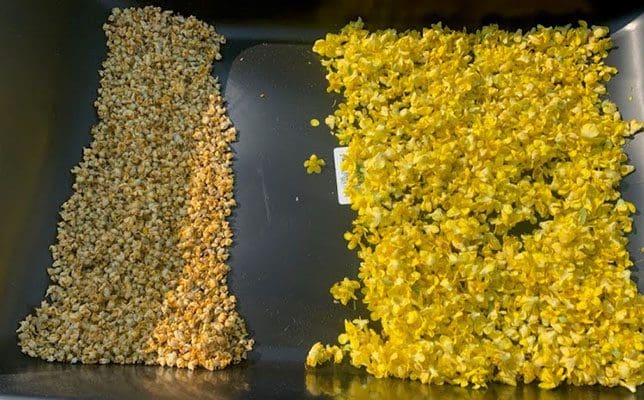
Dried Flowers vs Freshly Picked Flowers
Products:
Dried Mullein Leaves:
We have a 4/5th oz. (3 cups) of dried leaves in a pint jar for $3.00. (3 cups) of dried leaves in a pint jar for $3.00. We have a 4/5th oz. (3 cups) of dried leaves in a clear/silver resealable bag for $2.00.
We have 1 1/2 oz. (8 cups) of dried leaves in a quart jar for $4.00. We also have 1 1/2 oz. (8 cups) of dried leaves in a clear/silver resealable bag for $3.00.
It is used for many different things. People mainly use the leaves to make a tea to help with respiratory ailments, like cough or sore throat. It is very easy to make and lots of recipes are available.

4/5th oz. Dried Leaves

4/5th oz. Dried Leaves

11/2 oz. Dried Leaves

11/2 oz. Dried Leaves
Dried Mullein Flowers:
We have a 1/5th oz. (2/3 cups) of dried flowers in a 4 oz. mini jar for $6.00. A 1/5th oz. (2/3 cups) of dried flowers in a clear/silver resealable bag for $5.00.
We have a 4/5th oz. (2 1/4 cups) of dried flowers in a pint jar for $21.00. Then a 4/5th oz. (2 1/4 cups) of dried flowers in a clear/silver resealable bag for $20.00.
The flowers can also be used as an herb tea, these recipes are very easy to find.

1/5th oz. Dried Flowers

4/5th oz. Dried Flowers

4/5th oz. Dried Flowers

1/5th oz. Dried Flowers
Planting Information:
Cold Stratification will yield the best results. Directly sow the seeds outdoors in the fall so they can germinate the following spring. Plant them 8–12 inches apart on the soil surface and gently press in. Mullein can also be started indoors 6 weeks before the last frost. Seeds planted indoors will sprout in 12–15 days. If started indoors, cold stratify the seeds in the fridge for 4–6 weeks before planting. The best time to transplant them is when there is no chance of frost. These should be planted 20–24 inches apart.
Disclaimer:
This product has not been evaluated by the Food and Drug Administration for use to treat, cure, or prevent any illness. This product should not be used for human consumption. Consult your health care provider for guidance and advice before using this product.